
Underfloor HeatingInstallation ThatTransforms Your Home
Even, efficient warmth from the ground up — no radiators, no cold spots. We design, supply, and install wet underfloor heating systems tailored to your property, whether it's a new build, extension, or full renovation.
Bespoke system design • Compatible with heat pumps & boilers • 25+ years of heating expertise
25+ Years
Experience
Bespoke Layout
Design
Manufacturer Backed
Warranty
A-Rated Systems
Efficiency
Gas Safe Registered
Certified
Why Choose Underfloor Heating for Your Home?
Underfloor heating delivers gentle, radiant warmth evenly across every room — eliminating cold spots, freeing up wall space, and running at lower temperatures than traditional radiators. It's one of the most energy-efficient ways to heat your home, especially when paired with a condensing boiler or air source heat pump.
At Conroy Plumbing & Heating, we specialise in wet (hydronic) underfloor heating systems. These circulate warm water through a network of pipes embedded beneath your floor, providing consistent comfort without the convection draughts and dust circulation that radiators cause.
Whether you're building a new home in Bolton, adding an extension in Manchester, or renovating a kitchen or bathroom, underfloor heating adds comfort, value, and long-term energy savings. We handle everything from heat-loss calculations and pipe layout design to manifold installation and commissioning.
Every system we install is designed room-by-room, with pipe spacing and flow rates calculated to match the specific heat requirements of each space. This precision engineering is what separates a professionally installed system from a DIY kit.
Common Heating Problems Underfloor Heating Solves
Traditional radiator systems have limitations that many homeowners accept as normal — but they don't have to. Underfloor heating addresses these issues at the source.
- Cold floors in kitchens, bathrooms, and conservatories — underfloor heating turns the floor itself into a radiator
- Uneven room temperatures with hot spots near radiators and cold zones across the room
- Wasted wall space taken up by bulky radiators, limiting furniture placement and room design
- High energy bills from radiators running at 60-75°C — underfloor heating operates efficiently at just 35-45°C
- Dust circulation and dry air caused by convection heating from radiators
- Difficulty heating open-plan living spaces evenly without multiple radiators
Our Underfloor Heating Installation Process
Survey & Heat-Loss Calculation
We survey your property and perform room-by-room heat-loss calculations. This determines the pipe spacing, flow rates, and insulation requirements for each zone to guarantee even warmth throughout.
System Design & Layout
We produce a bespoke pipe layout plan showing exact pipe runs, manifold location, zone controls, and integration with your existing or new heat source. You approve the design before any work begins.
Insulation & Preparation
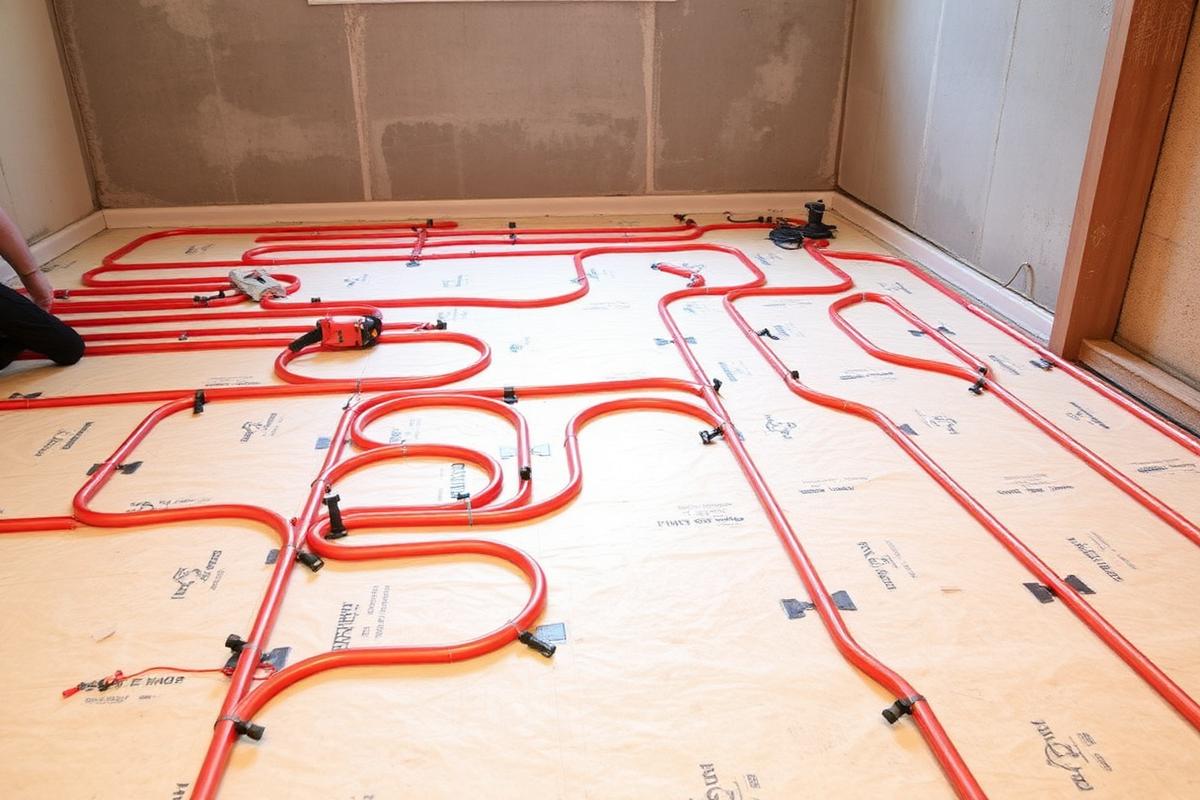
We install high-density insulation boards to direct heat upwards into the room, not downwards into the subfloor. Edge insulation strips are fitted to allow for thermal expansion.
Pipe Installation
PEX or PERT barrier pipe is laid in calculated loops, clipped to the insulation at the correct spacing. Each circuit is pressure-tested to 6 bar before any screed is applied.
Manifold & Controls
The manifold is fitted and connected, with individual zone actuators and a programmable thermostat for each area. This gives you independent temperature control room-by-room.
Commissioning & Handover
Once the screed has cured, we gradually commission the system over several days, incrementally increasing the water temperature. We walk you through the controls and provide full documentation.
Benefits of Professional Underfloor Heating
Even, Comfortable Warmth
Heat radiates evenly from the entire floor surface, eliminating cold spots and creating a consistent, comfortable room temperature from floor to ceiling.
Lower Energy Bills
Underfloor heating operates at 35-45°C compared to 60-75°C for radiators. This lower flow temperature means your boiler or heat pump runs more efficiently, reducing gas and electricity consumption.
Frees Up Wall Space
Without radiators on the walls, you gain full freedom for furniture placement, built-in storage, and interior design — particularly valuable in smaller rooms.
Compatible with Renewables
Wet underfloor heating is the ideal partner for air source heat pumps, which perform best at lower flow temperatures. Future-proof your home for renewable energy.
Reduced Dust & Allergens
Radiant heating doesn't circulate air the way convection radiators do, significantly reducing airborne dust and allergens — better for allergy sufferers.
Increases Property Value
Underfloor heating is a desirable feature for buyers and adds measurable value to your property, particularly in kitchens, bathrooms, and open-plan living areas.
Underfloor Heating: Technical Detail
Wet vs Electric Underfloor Heating
We install wet (hydronic) systems, which circulate warm water through pipes beneath the floor. Wet systems are significantly cheaper to run than electric mat systems and are the only type suitable for whole-house heating. Electric systems are better suited to single small rooms like en-suites where retrofitting water pipes would be impractical. For any project beyond a single room, wet underfloor heating is the professional recommendation.
Floor Build-Up & Screed Options
A typical wet underfloor heating installation adds 70-100mm to the floor build-up: 50mm insulation, 16mm pipe, and 50-65mm of liquid or sand-and-cement screed. For renovations where floor height is limited, we offer low-profile systems using aluminium diffuser plates that reduce the build-up to as little as 25mm. We advise on the best approach based on your specific floor construction.
Compatibility with Floor Coverings
Underfloor heating works with most floor types including tile, stone, engineered wood, LVT, and polished concrete. Tiles and stone are the most efficient conductors. Engineered wood and LVT work well with correct adhesive and a maximum surface temperature limit. We advise against thick carpet and underlay, which insulate the floor and reduce heat output significantly.
Zone Control & Smart Thermostats
Every system includes individual zone control via actuators on the manifold. Each zone has its own thermostat, allowing different temperatures in different rooms. We integrate with smart thermostats including Hive, Nest, and Drayton Wiser for remote control and scheduling. Multi-zone control is essential for efficiency — heating only the rooms you're using.
Integration with Existing Boilers
Wet underfloor heating connects to your existing combi or system boiler via a mixing valve that blends boiler water down to the correct flow temperature. If your boiler is due for replacement, we can design the entire system — boiler and underfloor heating — as an integrated package for maximum efficiency.
Frequently Asked Questions
Looking for something else? Phil also covers 24/7 emergency plumbing, full boiler installation and boiler repairs, annual boiler servicing, central heating installation, power flushing, leak detection and landlord gas safety certificates (CP12). Browse the full list on our services page or see recent jobs and customer reviews.
Based in Bolton, we work across Bolton, Manchester, Bury, Blackburn, Chorley, Wigan, Preston and Salford. See all areas we cover, learn more about Phil Conroy, or get in touch for a free quote.
Related Services
Ready to Get ThisSorted Properly?
Speak directly to Phil. No call centres, no scripts — just honest advice, fair pricing, and work you can rely on.